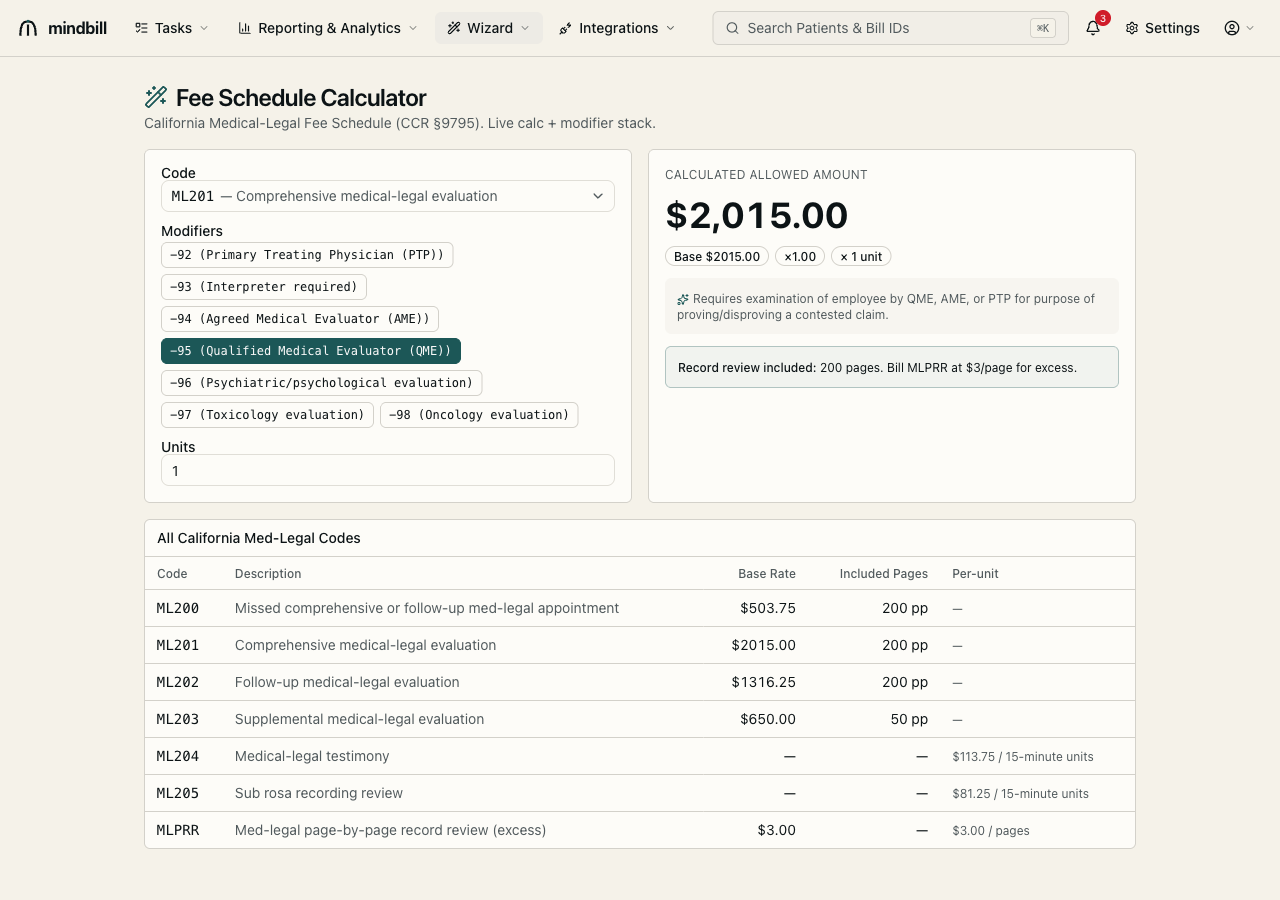
Step 1 — Pick a code and read the base allowance
Open the calculator (/wizard/fee-schedule). Choose a code (ML200–ML205 or MLPRR) and the Calculated Allowed Amount updates live. The flat-rate comprehensive codes are the workhorses: ML200 (missed appointment) $503.75, ML201 (comprehensive evaluation) $2,015.00, ML202 (follow-up, same evaluator within 18 months) $1,316.25, ML203 (supplemental) $650.00. Each comprehensive code includes review of the first 200 pages of records under CCR §9795(c), with excess pages billed separately as MLPRR at $3.00/page.
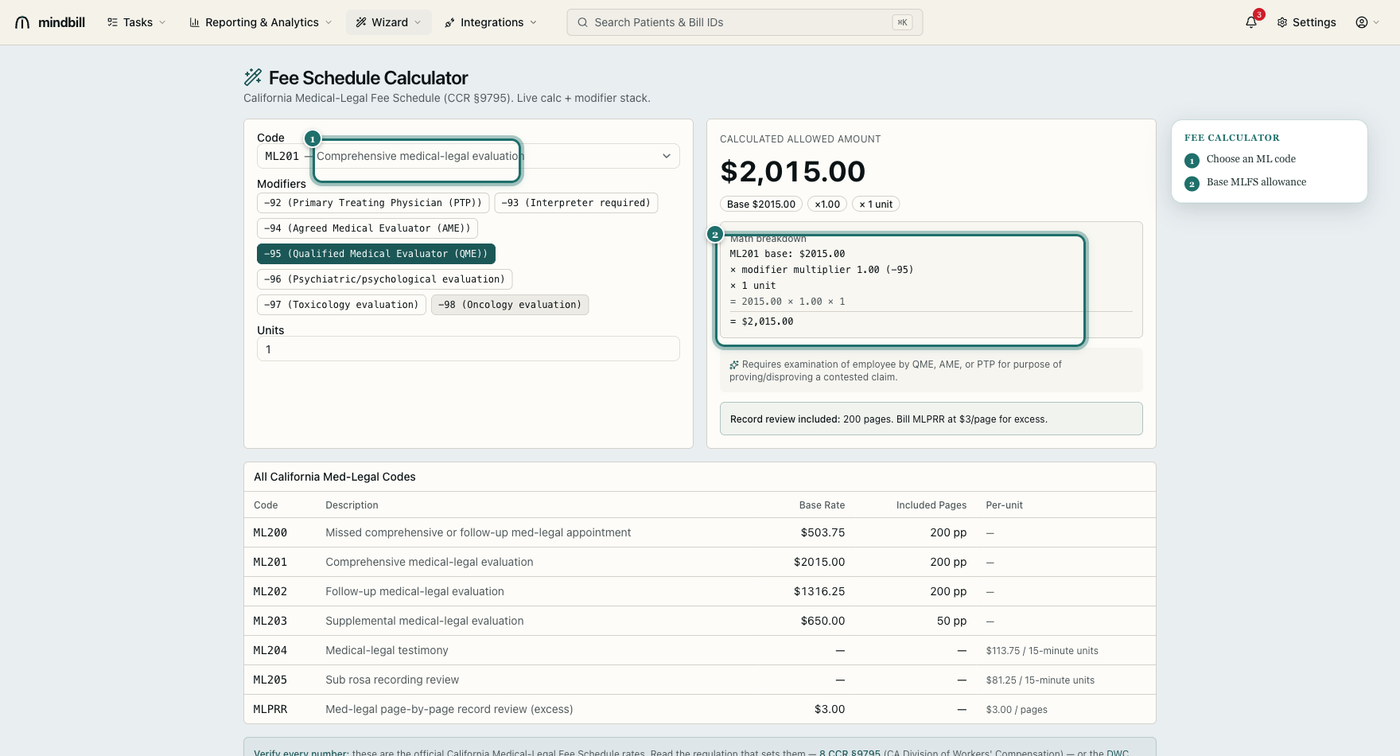
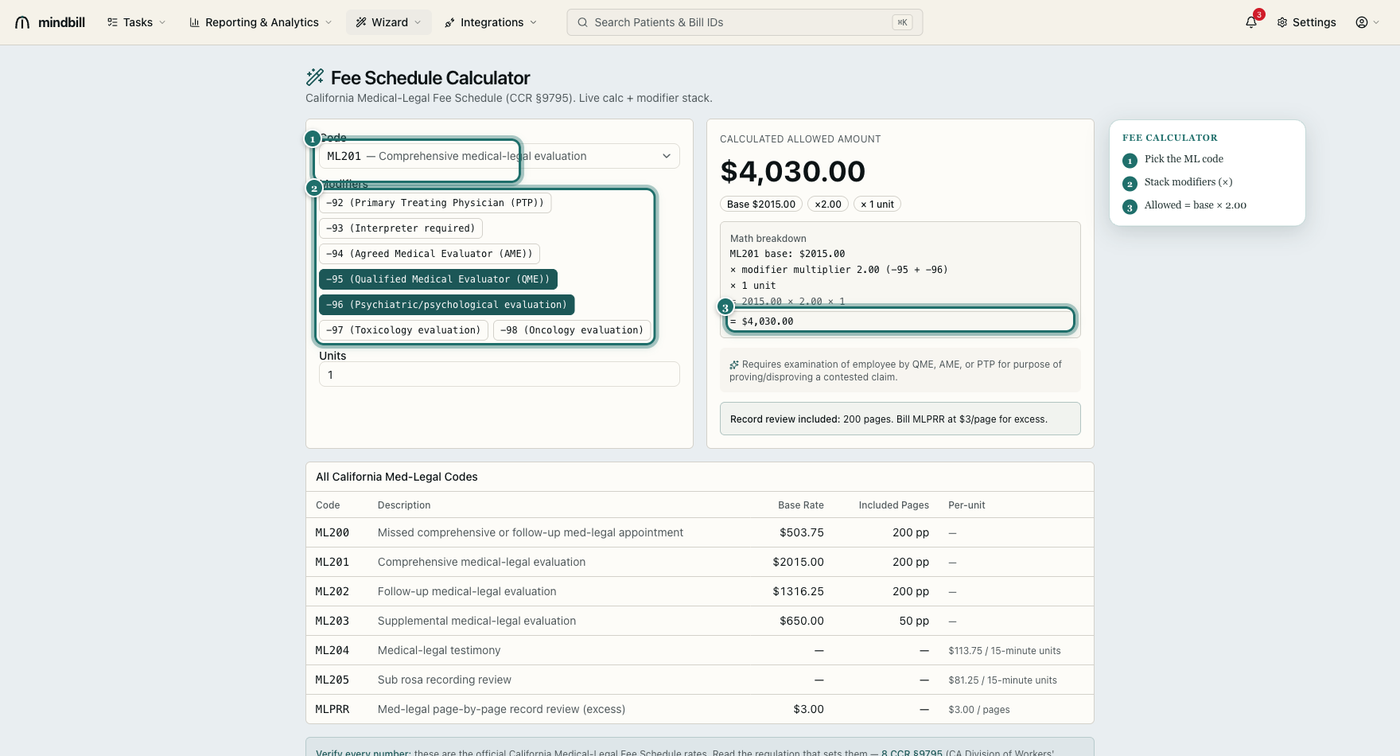
Step 2 — Stack modifiers (they multiply, not add)
Med-legal modifiers are composite multipliers, not flat add-ons — this is the single most-misunderstood part of the fee schedule. Check a modifier and the calculator applies its factor: 93 (interpreter) ×1.10, 94 (AME) ×1.35, 95 (QME) ×1.00, 96 (psychiatric) ×2.00, 97 (toxicology) ×1.50. So ML201 with modifier 96 isn't $2,015 plus an add-on — it's $2,015 × 2.00 = $4,030.00, shown live. When multiple modifiers apply, the factors compound. Getting this right is the difference between billing your full entitlement and leaving money on the table.
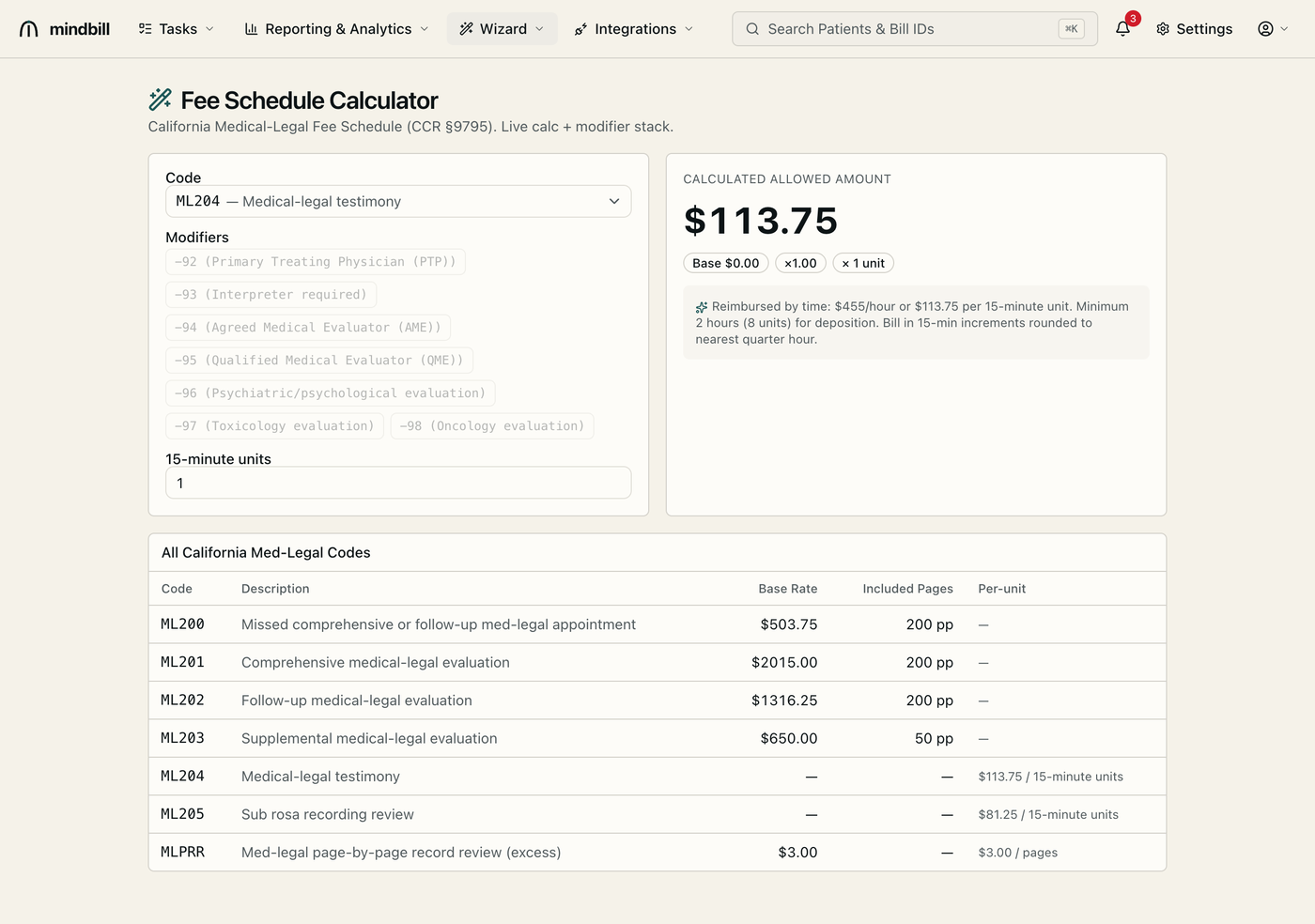
Step 3 — Handle the per-unit codes (testimony & record review)
Two codes price per unit rather than flat. ML204 (medical-legal testimony) bills at $455/hour — $113.75 per 15-minute unit — with a two-hour, eight-unit minimum, so even a short deposition bills at no fewer than eight units ($910.00). ML205 (sub rosa / recording review) bills at $325/hour, or $81.25 per 15-minute unit. MLPRR (excess record review) is $3.00 per page beyond the 200-page threshold. Set the units field and the calculator multiplies the per-unit rate accordingly, enforcing the ML204 minimum so a deposition prices correctly without manual math.
Step 4 — Use the reference table to defend a charge
Below the calculator, the All California Med-Legal Codes table lists every code with its base rate, included pages, and per-unit price — a one-screen reference you can cite line by line when a payer downcodes an ML201 to an ML202 or strips a modifier. Because this is the same engine bill entry uses, the number you compute here is authoritative: it's what your Allowed column shows, what your expected-reimbursement reports project, and what your Second Review rebuttal claims back.