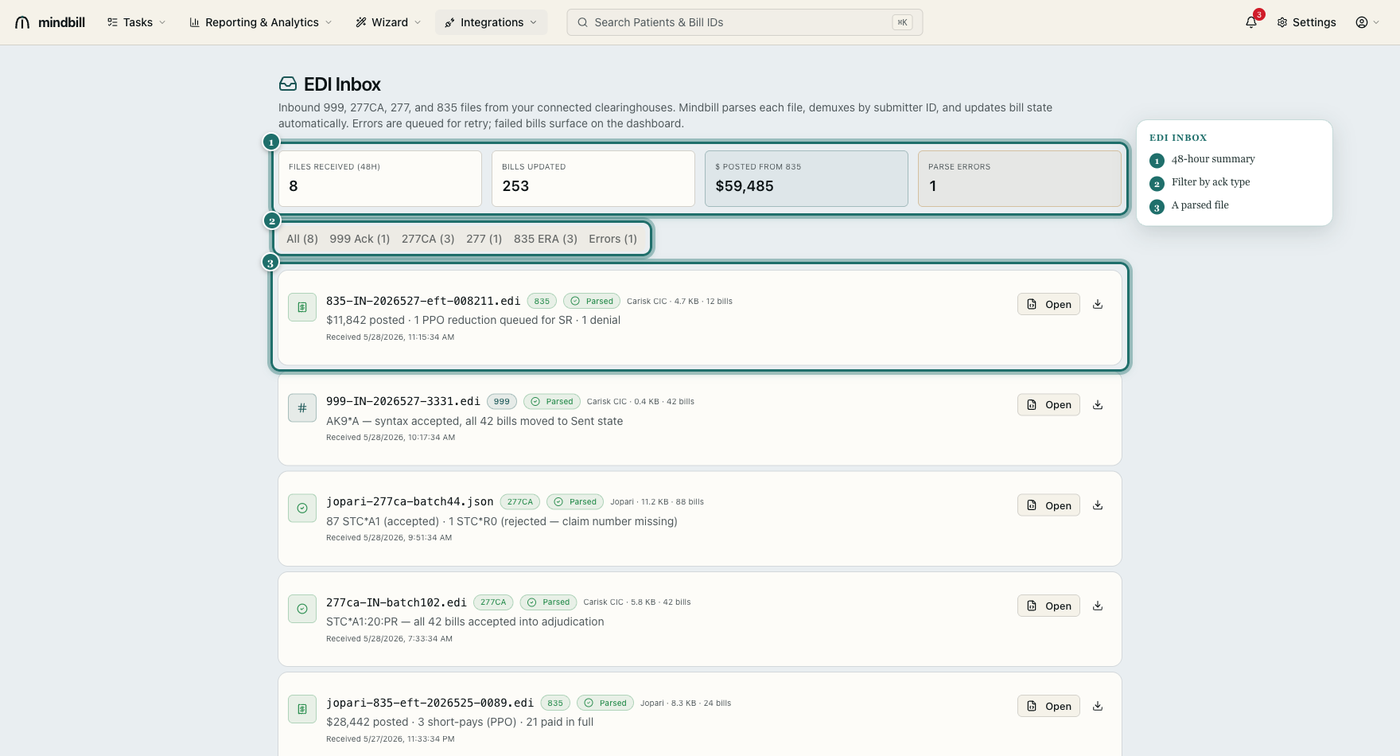
Step 1 — Read the inbox and the 48-hour summary
Open the EDI inbox (/integrations/edi-inbox). The header summarizes the last 48 hours — files received, bills updated, dollars posted from 835s, and parse errors. Below it, every inbound file is listed newest-first with its transaction type, clearinghouse, size, bill count, and a one-line outcome — e.g. a 999 reading 'AK9*A — syntax accepted, all 42 bills moved to Sent state,' or a 277CA reading '87 STC*A1 (accepted) · 1 STC*R0 (rejected — claim number missing).' That plain-English summary is the parsed result of the raw X12 you'd otherwise read by hand.
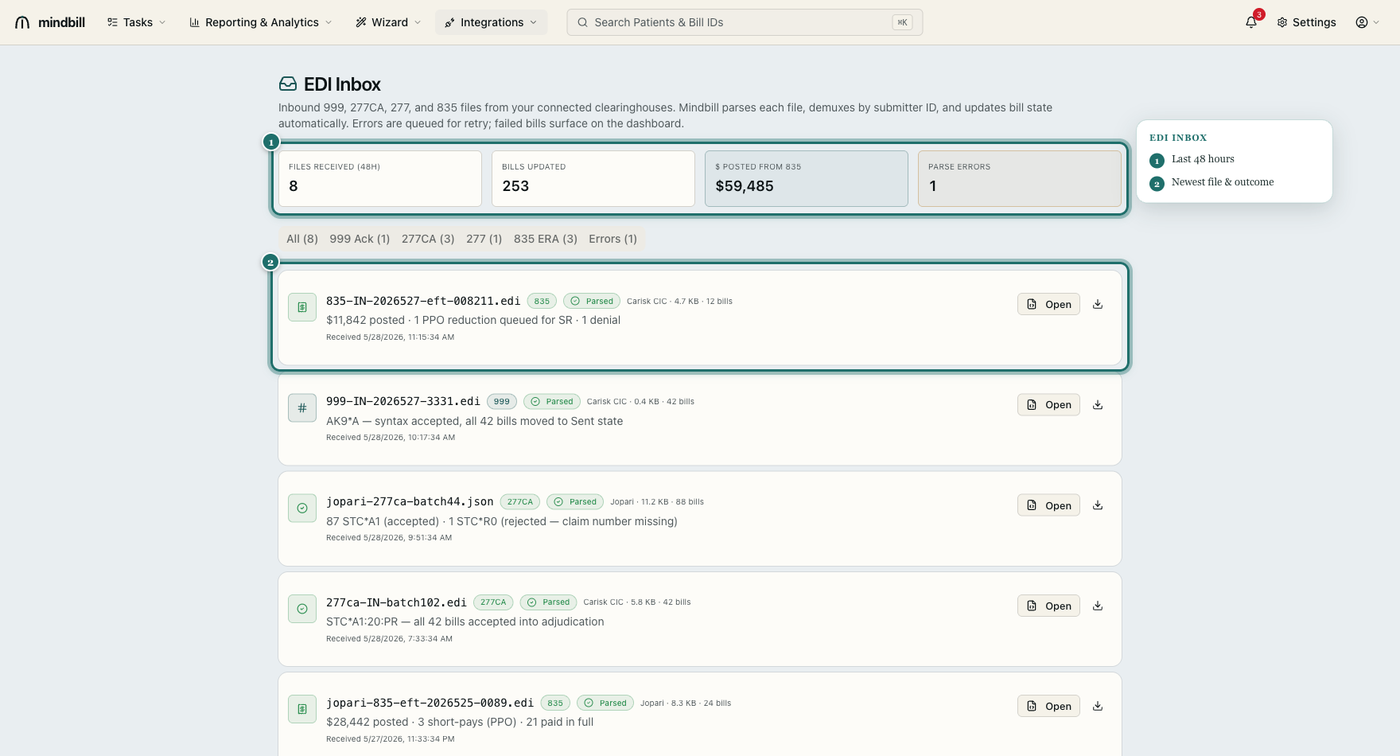
Step 2 — Understand the acknowledgment sequence
The four inbound types arrive in order and each moves the bill forward. The 999 functional acknowledgment confirms the clearinghouse received a syntactically valid file (AK9*A = accepted). The 277CA is the payer's claim-level acknowledgment — STC*A1 accepts the claim into adjudication, STC*R0 rejects it (with the reason, like a missing claim number). The 277 reports mid-cycle status. The tabs along the top — All, 999 Ack, 277CA, 277, 835 ERA, Errors — let you filter to one transaction type when you're chasing a specific stage of the cycle.
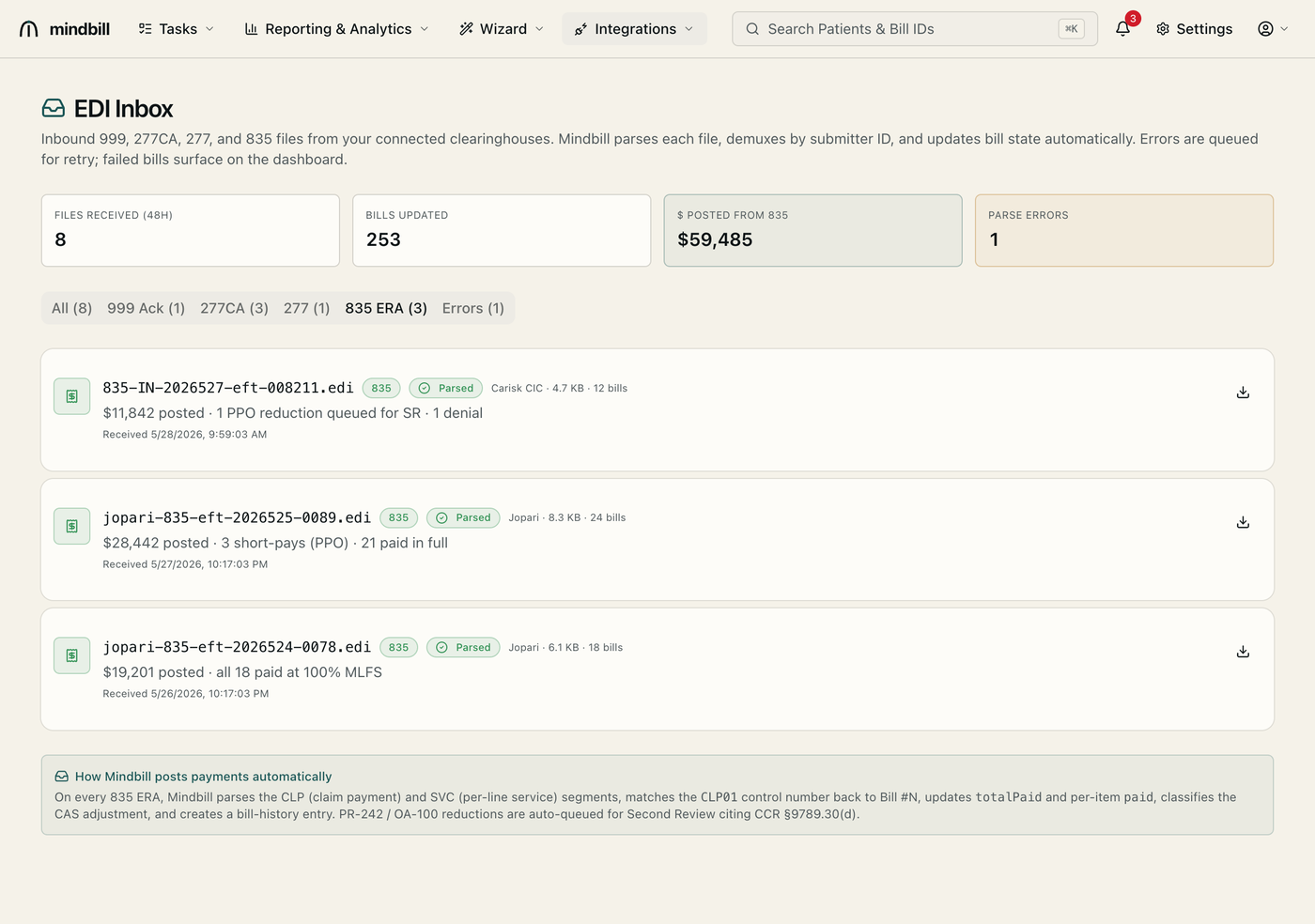
Step 3 — Open the 835 ERA where payment posts
The 835 electronic remittance advice is where money actually posts. Filter to 835 ERA and each file shows the dollars posted and how the lines resolved — e.g. '$28,442 posted · 3 short-pays (PPO) · 21 paid in full.' Mindbill decodes the CAS adjustment codes on each 835 and posts the payment to the matching bill, computing the variance against the Medical-Legal Fee Schedule. When it spots an illegal PPO/MPN reduction (PR-242 on a med-legal bill), it flags the short-pay and queues the Second Review playbook instead of letting it pass as 'paid.'
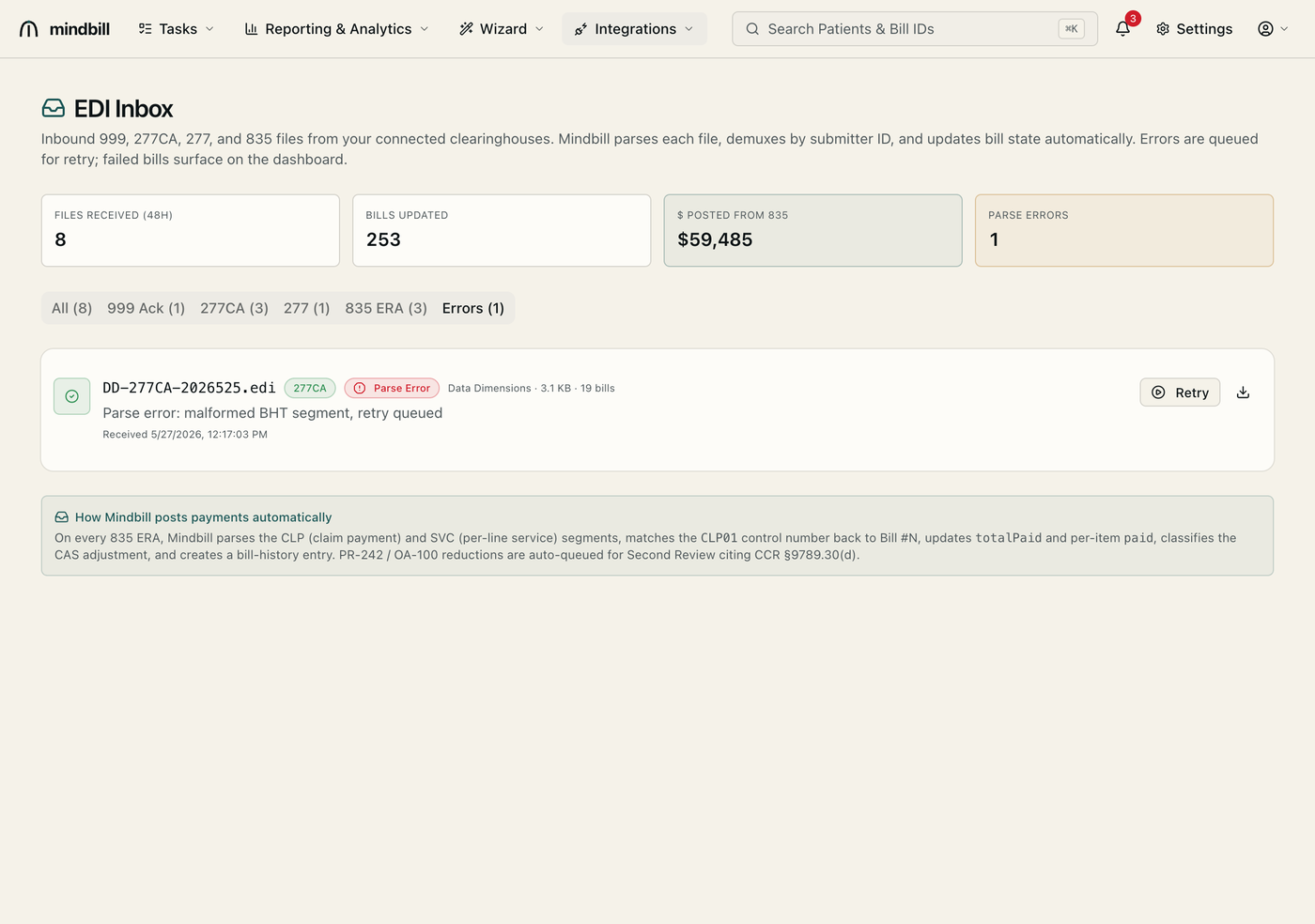
Step 4 — Clear parse errors and retries
Not every file parses cleanly — a clearinghouse can send a malformed segment (e.g. 'Parse error: malformed BHT segment'). The Errors tab isolates these, and each carries a Retry action so you can re-attempt the parse once the upstream file is corrected, without losing the bills it covers. Because every parsed transaction is timestamped and matched to its bill, the inbox doubles as your acknowledgment trail — proof of exactly when each ack and remittance arrived if a payer later disputes timing.