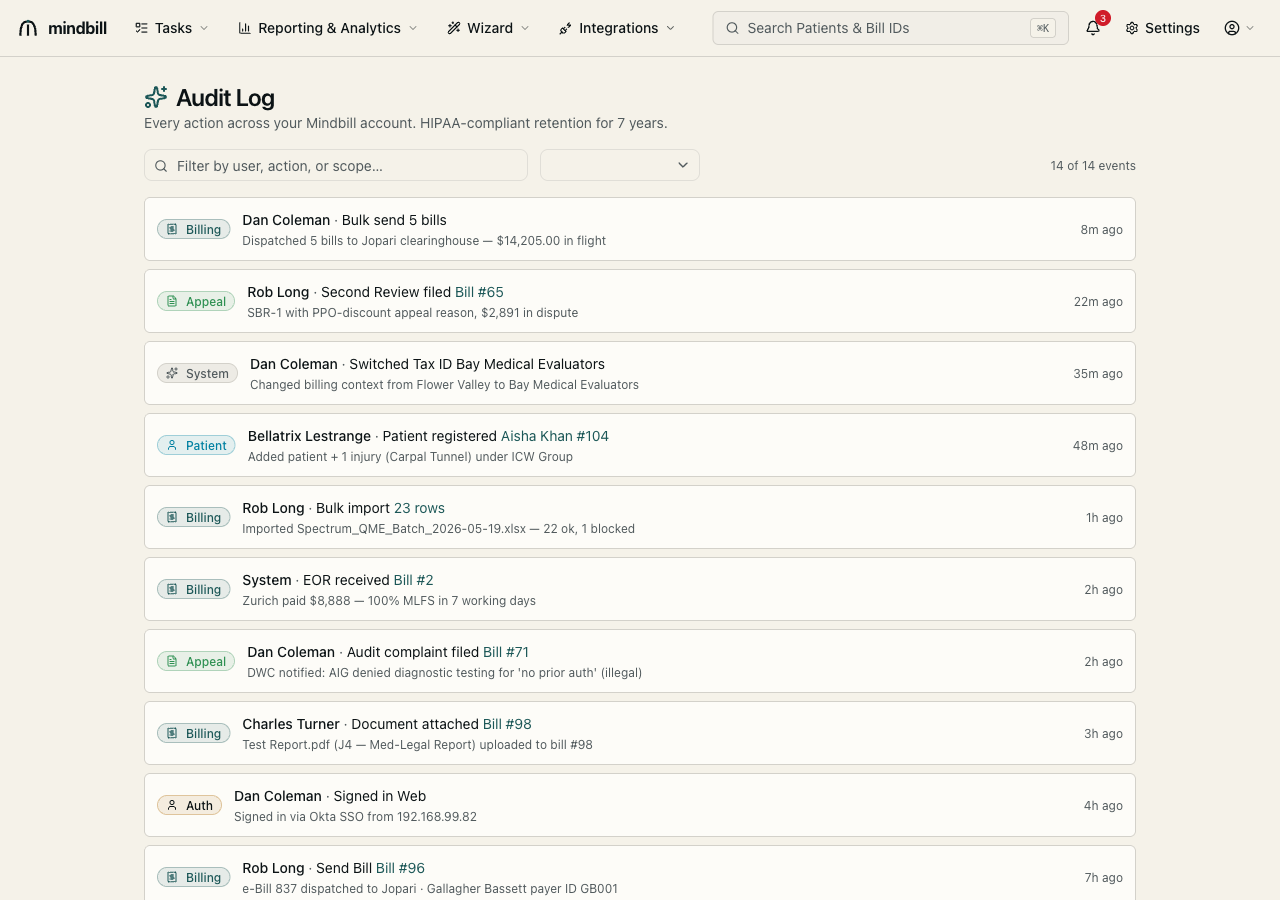
Step 1 — Open a bill and find its history
Open any bill from the bill list (here, an appealing bill, #65). The detail page carries a Bill / Bill History tab pair near the top; the count badge on Bill History tells you how many events the bill has accumulated. The Bill tab shows the current state — payment cycle, line items, totals, documents — while Bill History is the chronological record of how it got there.
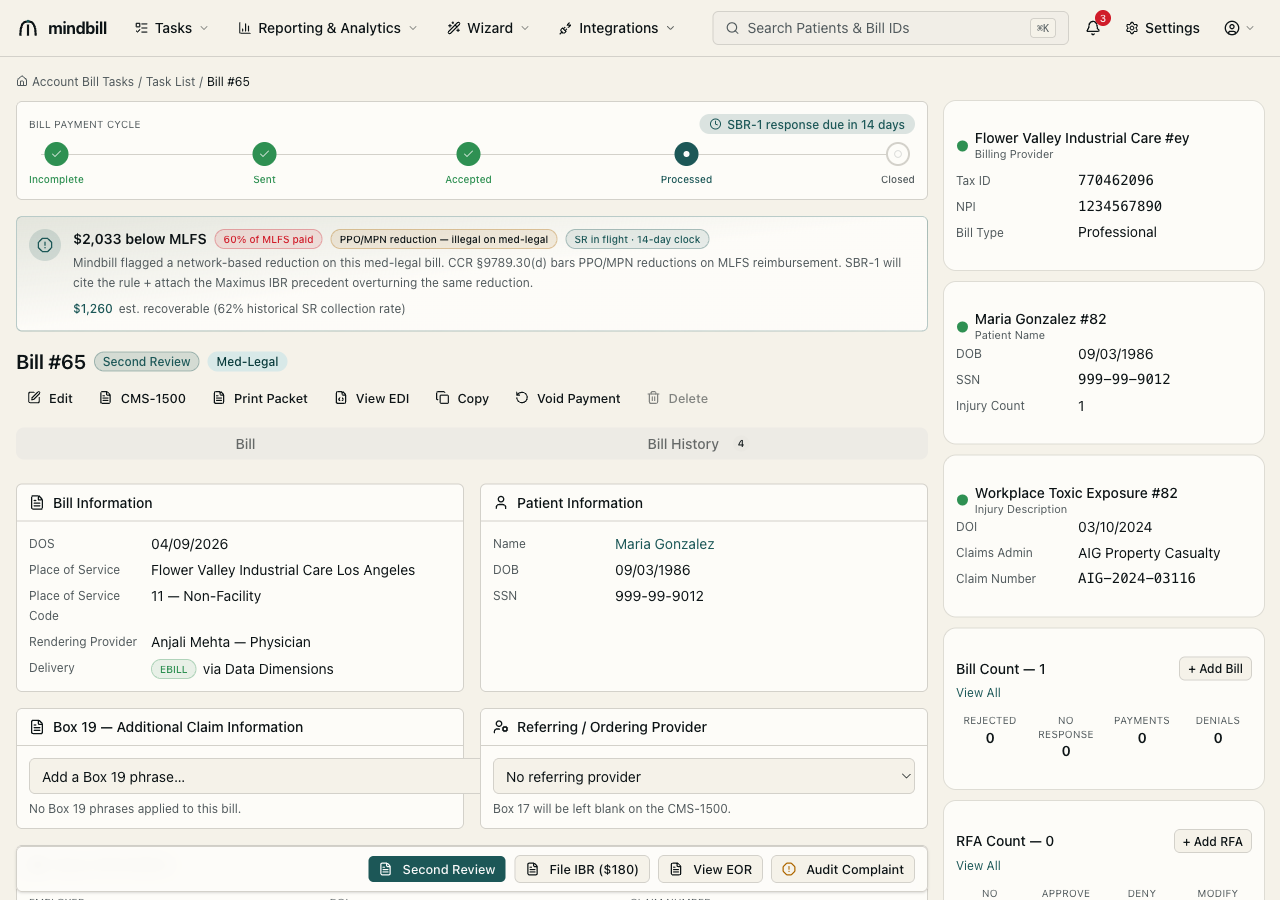
Step 2 — Read the activity timeline
Open the Bill History tab for the Bill Activity Timeline — every event, timestamped and dollar-tagged. A typical med-legal dispute reads: Bill created (Apr 9, 9:00 AM) → e-Bill 837 dispatched to Data Dimensions, Payer ID AIG02 (Apr 9, 10:00 AM, EBILL) → EOR received — AIG applied PPO discount (illegal on med-legal), paid 60% MLFS (Apr 17, $2,226.00) → Second Review (SBR-1) generated and dispatched citing illegal PPO reduction (May 13). Each entry captures what happened, when, and through which clearinghouse and payer ID.
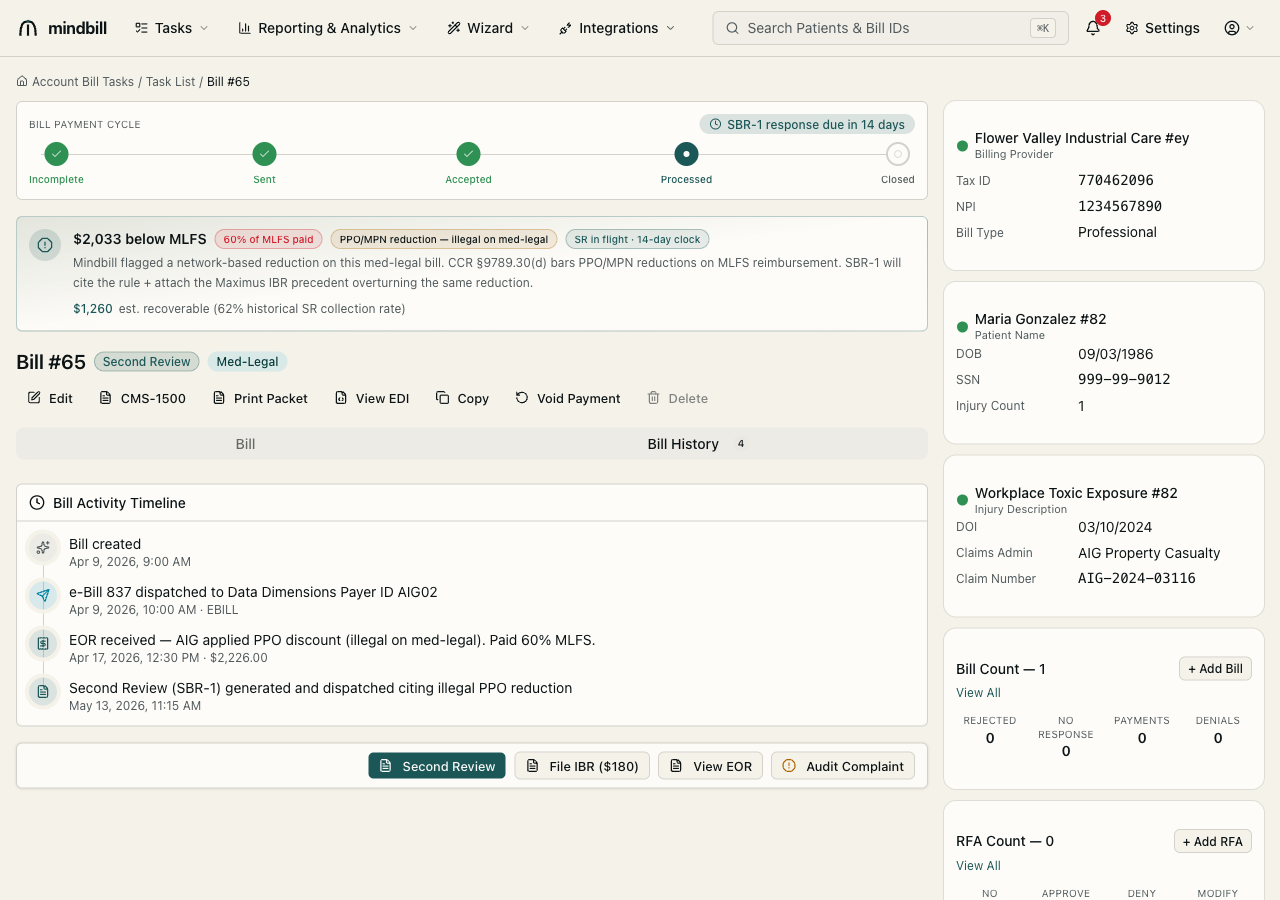
Step 3 — Act straight from the timeline
The timeline isn't just a log — the appeal actions sit right alongside it: Second Review, File IBR ($180), View EOR, and Audit Complaint. So when you read that an EOR posted at 60% MLFS, you escalate from the same screen, and that escalation lands as the next timestamped event. This is how the history stays complete: every action you take on the bill is itself recorded, in order, with no manual note-keeping.
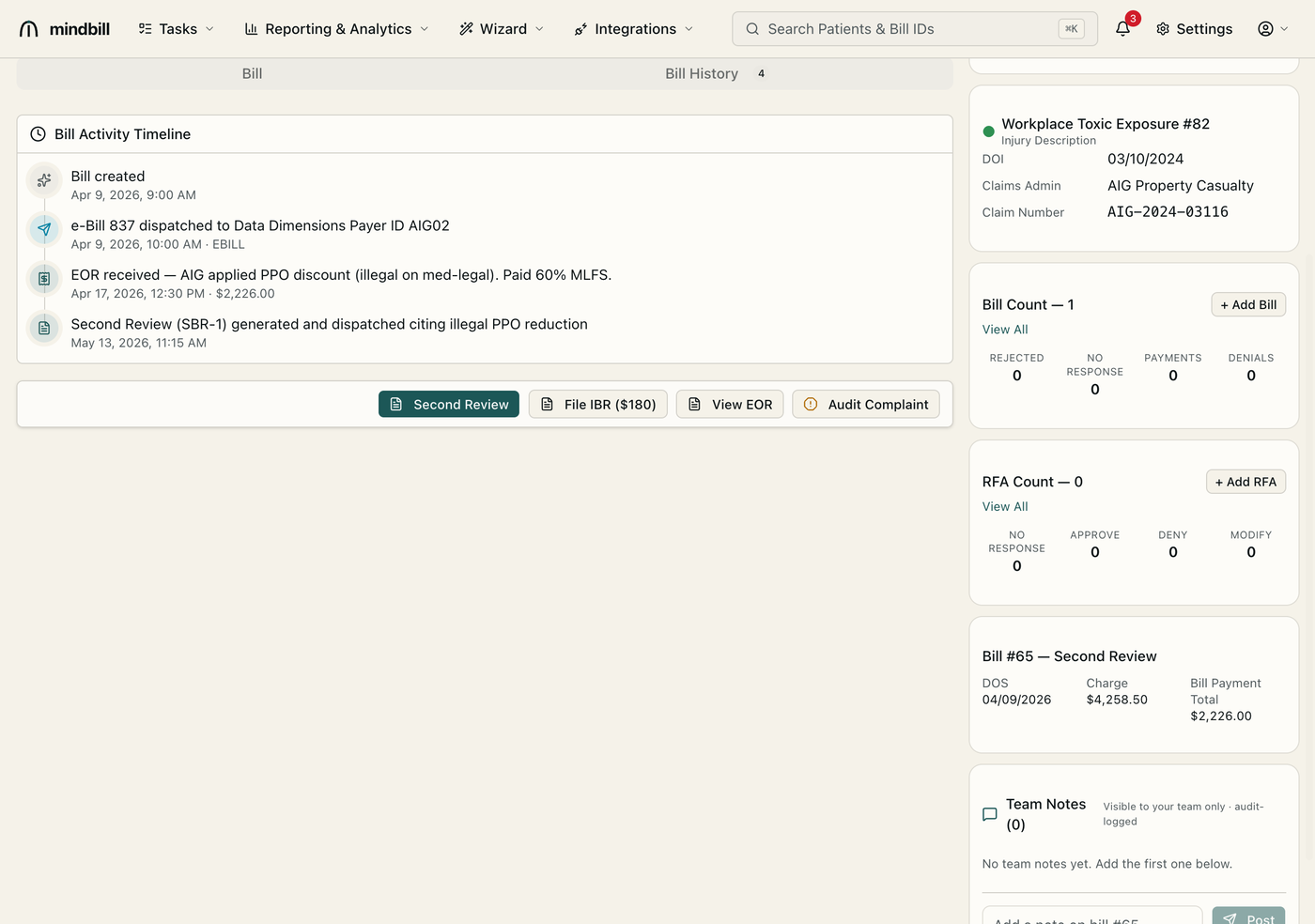
Step 4 — Use the history as legal evidence
Because the timeline records the send timestamp, the clearinghouse, the payer ID, and each acknowledgment, a payer can never credibly dispute when you submitted or when their EOR was late. The account-wide audit log captures who did what and when across all bills, with 7-year retention per HIPAA. When the DWC Audit Unit asks for a paper trail — or you're computing the day count for a §4622 penalty — the evidence is already assembled on the bill.